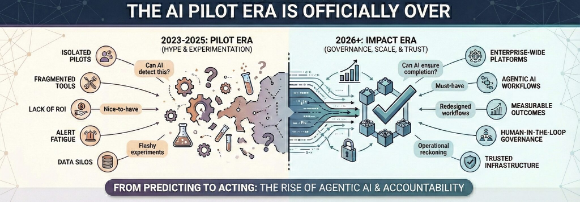
If the last two years were defined by the breathless hype of experimentation, 2026 marks the healthcare industry’s decisive transition from “flashy, one-off experiments” to “top-down programs designed for measurable impact”. Across the digital health landscape, executives agree that the “pilot era is ending,” with the focus shifting entirely to systems that can be “governed, audited, and trusted” at scale.
The narrative for the coming year is no longer about the novelty of generative AI models, but the emergence of “Agentic AI”—tools that move from “predicting to acting” and platform-based workflows where the question changes from “Can AI detect this?” to “Can AI ensure this is completed?”.
From the “invisible” integration of AI into clinical operations to the hard reality that organizations must “redesign our workflows” rather than merely speed up broken processes. As we look toward 2026, healthcare executives forecast a year of operational reckoning, where success will be defined not by technological capability, but by the “hard work required to make AI meaningful.
Jim Szyperski, CEO, Acuity Behavioral Health
AI Can Transform Behavioral Care, but Only If the Industry Fixes Its Data First
Thoughtfully designed and implemented, AI and data-driven automation is and will be indispensable in behavioral healthcare for clinical decision support for trained staff. It is an extremely valuable tool to aggregate information that would otherwise take hours, days, weeks, to gather. IMO, it should be used solely to inform and suggest in clinical settings, and not to replace clinical decision making.
But effective use of AI/data-driven use in behavioral healthcare clinical settings requires standardized measurements being used industry wide, and that is currently far from the case in behavioral healthcare. Everyone operates their clinical environments differently, and clinical care from site to site is subjective,qualitative, resulting in little to no data that can be used for industry analysis, development of best practices, etc. In this sense, AI has become a buzzword for innovation, perhaps posturing, in behavioral healthcare, and may have the impact of increasing variability rather than creating standards.
Click here to read the entire article with more healthcare executives' AI predictions for 2026.